Spotify analytics for artists can be one of the most useful tools for understanding how your music is performing and who is listening. Instead of looking at streams as simple numbers, artists can use their Spotify data to understand their audience, identify opportunities, improve their marketing, and make smarter decisions about future releases.
This is where Spotify analytics becomes valuable.
Spotify analytics gives artists access to information about how people are interacting with their music. Instead of relying on assumptions, you can use this data to understand your audience, identify opportunities, improve your marketing, and make smarter decisions about future releases.
But having access to data isn’t enough. You need to know how to use it.
Here are practical ways you can turn your Spotify analytics into an advantage.
1. How Spotify Analytics for Artists Helps You Understand Your Audience
One of the first things you should pay attention to is your audience.
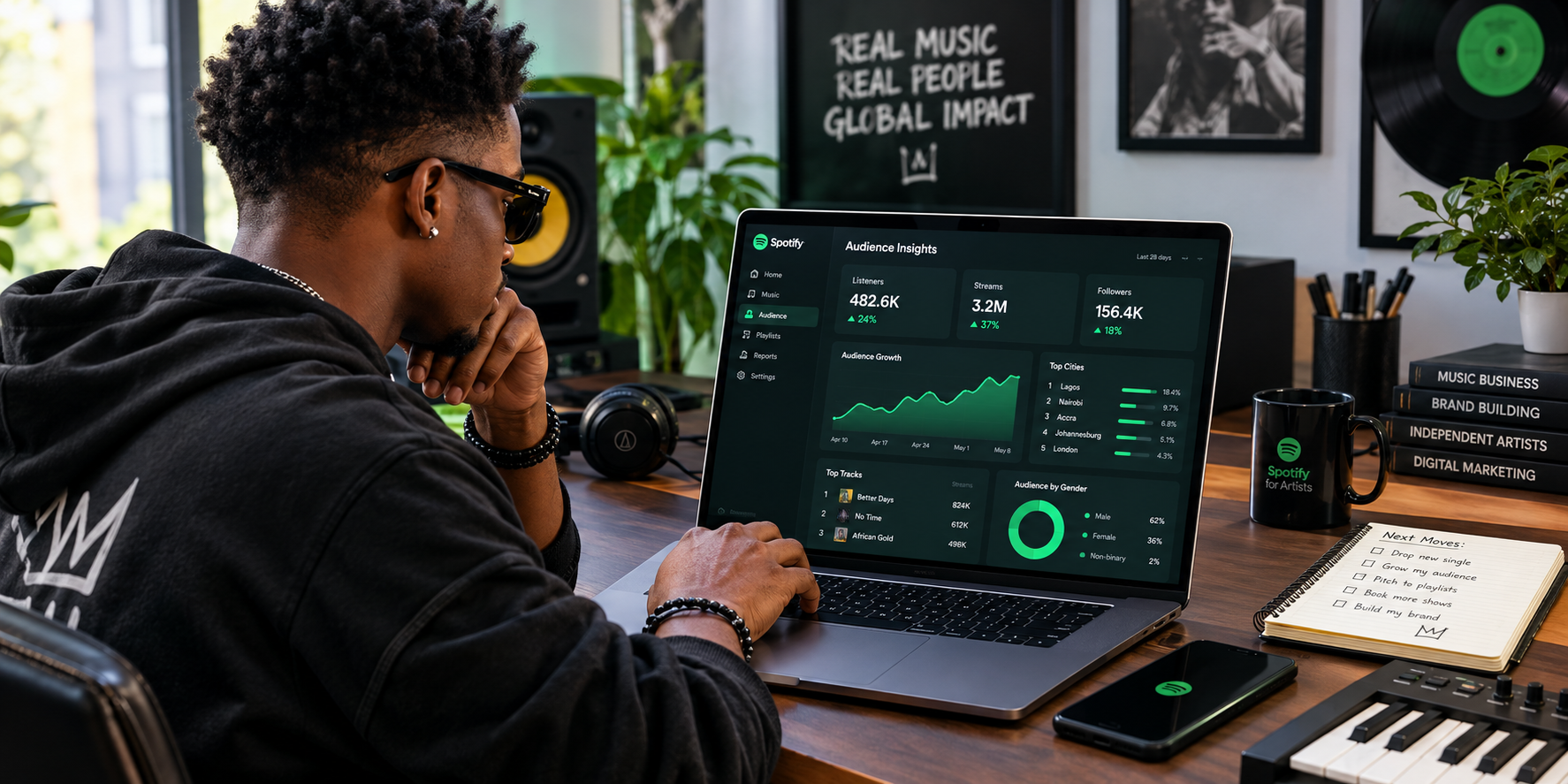
Your analytics can help you understand the number of listeners engaging with your music and how that audience changes over time.
Don’t only focus on your total streams. Look at your listeners and how they are growing.
For example, if your latest release brings in 5,000 new listeners, that’s an important signal. It means your music is reaching people who may not have listened to you before.
The question then becomes:
How do I turn those new listeners into long-term fans?
This can influence your social media strategy, content, mailing list, live shows, and future releases.
2. Find Out Where Your Listeners Are
Your audience isn’t necessarily concentrated where you live.
Spotify analytics can reveal the cities and countries where people are listening to your music.
This information can help you identify potential markets.
For example, an artist based in Kaduna might discover that their music is gaining significant traction in Lagos, Accra, London, or another unexpected market.
That’s an opportunity.
Once you identify these locations, you can:
- Target advertising campaigns towards those markets.
- Connect with local bloggers and media outlets.
- Reach out to playlist curators.
- Collaborate with artists in those locations.
- Explore performance opportunities.
- Create content specifically for those audiences.
Instead of promoting everywhere, use your data to identify where your audience already exists.
3. Using Spotify Analytics for Artists to Find New Markets
Not all streams happen the same way.
People can discover your music through different Spotify analytics for artists, including playlists, search, your artist profile, algorithmic recommendations, and other sources.
Understanding your discovery sources can help you determine what’s actually driving your growth.
If a large percentage of your listeners are discovering your music through playlists, for example, playlist strategy may deserve more attention.
If people are finding you through search, your artist profile and online presence may be playing a bigger role.
The goal is to answer one important question:
How are people finding me?
Once you know the answer, you can invest more effort into the channels that are producing results.
4. Identify Your Best-Performing Songs
Every song in your catalogue will not perform equally.
Your analytics can help you identify the songs that are connecting most strongly with listeners.
Don’t immediately assume your song with the highest number of streams is your most valuable track.
Look at different signals and compare them over time.
You may discover that an older song is suddenly gaining new listeners, or that a relatively new release is growing faster than everything else in your catalogue.
When you identify a song with momentum, give it more attention.
Create additional content around it. Push it on social media. Perform it live. Tell the story behind it.
Sometimes the song you thought was finished still has more room to grow.
5. Use Your Data to Improve Your Release Strategy
Your previous releases can teach you how to approach your next one.
After every release, take time to review what happened.
Ask yourself:
- How many listeners did the release attract?
- Where did those listeners come from?
- Which cities showed the most interest?
- Which playlists contributed to discovery?
- How long did the song maintain momentum?
- What happened after your promotional campaign ended?
You can then compare those results with your previous releases.
Over time, you’ll begin to recognize patterns.
Maybe your audience responds better when you start promoting a song two weeks before release.
Maybe certain types of content generate more Spotify traffic.
Maybe collaborations consistently introduce your music to new listeners.
Your data can help you turn these observations into a repeatable strategy.
6. Don’t Ignore Your Catalogue
One common mistake artists make is focusing entirely on their newest release.
Your catalogue can continue working for you long after a song is released.
Use your analytics to identify older songs that are still attracting listeners.
If an older track starts gaining traction, consider bringing it back into your content strategy.
You could create:
- A new performance video
- Behind-the-scenes content
- A lyric video
- Short-form videos
- A live version
- A story about the song
- A remix or collaboration
Your next big opportunity might already be sitting inside your catalogue.
7. Turn Spotify analytics for artists Data Into Social Media Content
Your analytics can also influence what you post online.
For example, if you discover that you have listeners in a country you’ve never visited, that’s a content opportunity.
You could create a post saying:
“I just discovered that people in [country] are listening to my music. Thank you!”
This turns data into a conversation with your audience.
You can also celebrate milestones, share interesting audience statistics, and use your growth as part of your storytelling.
Your analytics doesn’t have to remain hidden inside your dashboard.
Turn your progress into content.
8. Identify Potential Markets Before Spending Money
Marketing can become expensive when you’re promoting blindly.
Your Spotify data can help you make more informed decisions about where to spend your budget.
If your analytics show that you already have an audience in a particular city, targeting that location with advertising may make more sense than spending the same amount of money trying to introduce yourself to an entirely cold audience.
This doesn’t mean you should only advertise where you already have listeners.
It means your existing data can help you make smarter experiments.
Test a market. Measure the result. Learn from it. Then decide what to do next.
9. Measure Growth Beyond Streams
Streams are important, but they shouldn’t be the only number you care about.
Consider the bigger picture.
Are you gaining new listeners?
Are people returning to your music?
Are your audience numbers growing after every release?
Are more people discovering your older catalogue?
Are certain markets becoming stronger?
These questions give you a better understanding of your career than simply celebrating a stream milestone.
A song can have millions of streams and still provide very little insight if you don’t understand where those streams came from.
Data becomes powerful when you understand the story behind the numbers.
10. Create a Regular Spotify analytics for artists Routine
You don’t need to check your Spotify analytics every few hours.
Instead, create a simple review system.
After Release
Look at the initial response and identify where listeners are coming from.
After 2–4 Weeks
Review listener growth, discovery sources, locations, and the performance of the release.
After 30–90 Days
Compare the release with previous songs and identify what worked and what didn’t.
Keep notes.
Over several releases, these records will help you understand your own audience better.
11. Use Your Spotify analytics for artists Data to Make Decisions, Not Assumptions
One of the biggest advantages analytics gives an independent artist is the ability to replace assumptions with evidence.
You might believe that your biggest audience is in your hometown.
Your data might tell you otherwise.
You might think your newest song is your strongest release.
Your analytics might reveal that an older song is attracting more new listeners.
You might assume social media is your biggest source of discovery.
Your data might show that playlists are responsible for a significant portion of your growth.
That’s why analytics matters.
It doesn’t tell you everything, but it gives you information that can help you ask better questions and make better decisions.
Final Thoughts
Spotify analytics shouldn’t be treated as a scoreboard that you check after releasing a song.
Think of it as a tool for understanding your career.
Use it to understand your audience, identify new markets, discover which songs have potential, improve your marketing strategy, and plan future releases.
The goal isn’t simply to get more streams.
The goal is to understand why you’re getting those streams and how you can turn that attention into a growing audience.
So the next time you open your Spotify analytics, don’t just ask:
“How many streams did I get?”
Ask:
“Who is listening?”
“Where are they?”
“How did they find me?”
“Which songs are connecting?”
“What can I learn from this?”
Because when you stop looking at analytics as numbers and start treating them as insights, your data can become one of the most useful tools in your music career.