Music industry jargon can feel like an intentional barrier to entry. The terms are complex, the acronyms are endless, and the landscape often feels gatekept by major labels.
At Yivera, we believe that transparency is the ultimate equalizer. To build a sustainable career as an independent creator, you have to move past simply “dropping music” and start managing your intellectual property like a business. That means knowing exactly how your art generates money, how it’s protected, and how to claim every single cent you are owed.
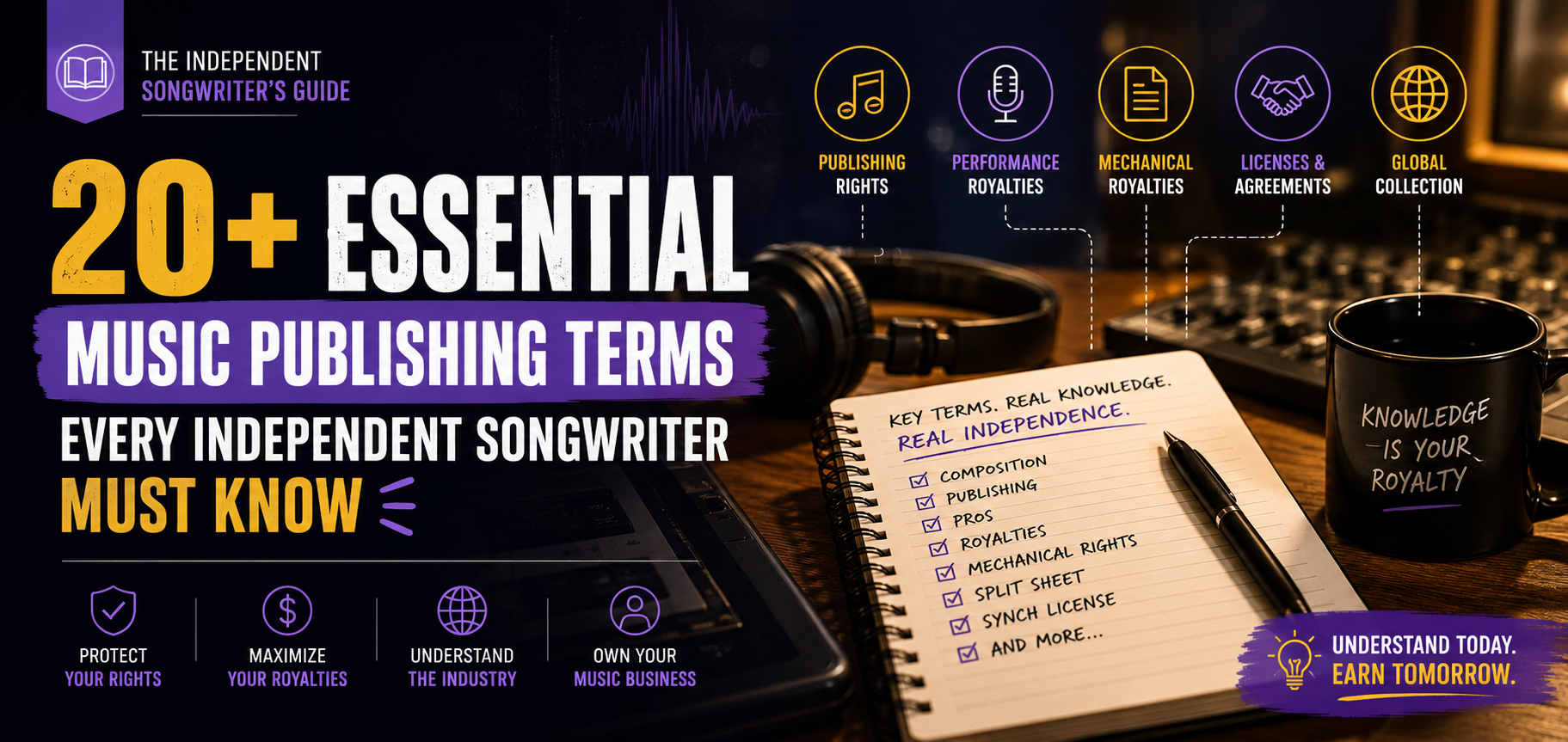
Here is your definitive glossary of the 20 basic music publishing terms and definitions you need to master to hold your own with industry professionals.
The Basics of Music IP
1. Composition
A composition is the foundational blueprint of a song—the specific combination of melody, lyrics, beats, and arrangement. Do not confuse this with the audio file you upload to streaming platforms. One single composition can have hundreds of different recorded versions (like covers or remixes), but the original writers still own the underlying composition.
2. Sound Recording (The Master)
The sound recording—commonly referred to as the Master—is the specific recorded performance of a composition.
The Classic Example: Dolly Parton wrote the composition “I Will Always Love You” in 1973. Decades later, Whitney Houston recorded a legendary vocal performance of that exact song for a record label. In this scenario, the label and/or Whitney owned that specific sound recording, but Dolly Parton (and her publisher) continued to own the composition.
3. Music Publishing
Music publishing is the business side of managing, protecting, and protecting the rights and royalties generated by your compositions. When your original song is fixed in a tangible medium (like a voice note, a demo tape, or a digital audio workstation session), it is protected by copyright. Music publishing ensures that whenever that composition is used commercially, you get paid.
4. Royalties
Royalties are the actual payments made to rights holders (songwriters, composers, and artists) for the licensed use of their work. Because compositions and sound recordings are separate assets, they generate separate royalty streams:
- Sound Recording Royalties: Collected via your digital music distributor (like Yivera) or your record label.
- Composition (Publishing) Royalties: Collected via Performance Rights Organizations (PROs), Mechanical Rights Societies, and Publishing Administrators.
How Publishing Royalties Are Generated
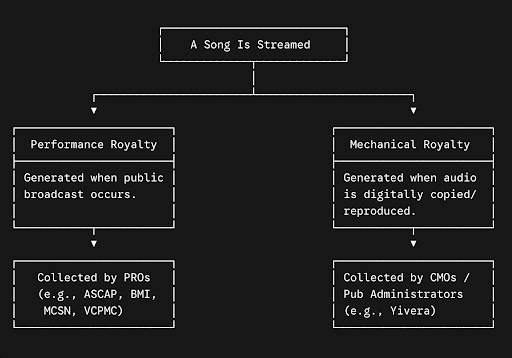
5. Performance Royalties
A performance royalty is owed to a songwriter whenever their composition is performed or broadcast publicly. This isn’t limited to live concerts; it includes your music being played on terrestrial or satellite radio, in hotels, bars, supermarkets, television broadcasts, and on digital streaming platforms (DSPs).
6. Mechanical Royalties
A mechanical royalty is generated every time a composition is reproduced either physically or digitally. Historically, this meant printing physical vinyl or CDs. In the streaming era, an interactive digital stream or download counts as a “digital reproduction” of your note and lyric structures, triggering a mechanical royalty alongside the performance royalty.
7. Interactive vs. Non-Interactive Streams
Not all streams are created equal in the eyes of publishing:
- Interactive Streams: When a user actively selects your song to play on Spotify, Apple Music, or Boomplay. These generate both performance and mechanical royalties.
- Non-Interactive Streams: When a platform chooses the music for the listener, such as an algorithmic radio station, Pandora, or satellite radio. These generally only generate performance royalties.
The Creators & The Contracts
8. Share
Your share refers to the exact percentage of a specific composition that you legally own and control. If you wrote a song completely by yourself, your share is 100%. If you co-wrote it with a producer, your shares must be clearly defined and total 100% collectively.
9. Split Sheet
A split sheet is a simple, written legal agreement between the co-writers of a composition that explicitly states who owns what percentage of the final song.
Yivera Tip: Never wait until a song becomes a hit to talk percentages. Fill out a split sheet during or immediately after the studio session to safeguard your income and preserve your creative relationships.
10. Composer vs. Lyricist
A composer is the individual who authors the musical elements of a composition (the beat, the chords, the instrumentation, or the riffs). A lyricist is the person who writes the words and vocal melodies. Whether you contribute a drum pattern or a hook, you are legally considered a songwriter and are entitled to a share of the publishing.
11. Work-for-Hire
A work-for-hire agreement is a contract where a creator is hired to write or record music for a project, company, or third party, usually in exchange for a flat, one-time fee. Under standard work-for-hire terms, you surrender your copyright ownership to the entity that hired you. Always read these contracts carefully with legal counsel before signing your rights away.
Rights, Administration, & Licensing
12. Performance Rights Organization (PRO)
PROs are collective societies that license, track, and collect performance royalties for songwriters and publishers. Examples include ASCAP and BMI in the United States, MCSN in Nigeria, or VCPMC in Vietnam. They issue massive blanket licenses to streaming services, venues, and radio stations so indie creators can get paid at scale.
13. Publishing Administrator
A publishing administrator is a company hired by a songwriter to register their songs globally, pitch for opportunities, and collect all worldwide publishing royalties (especially mechanical royalties, which PROs do not handle). When you utilize Yivera Publishing Administration, you retain 100% copyright ownership of your music—you are simply hiring our backend infrastructure to collect the money that would otherwise sit unclaimed in global royalty black boxes.
14. Letter of Direction (LOD)
A Letter of Direction is a formal, industry-standard document sent to global collection societies notifying them that a publishing administrator (like Yivera) has been authorized to manage your catalog and collect royalties on your behalf. An LOD does not give up your ownership; it simply tells societies where to route your money.
15. Music Catalog
Your catalog is the complete collection of musical works you own, co-own, or control. Maintaining an organized, up-to-date registry of your catalog data (including metadata and international codes) is the single most important step to preventing your royalties from going into “cold storage” or slipping away entirely.
Sampling, Covers, & Creative Modifications
16. Cover
A cover is a new recording of an existing composition by a different artist. Covers generate publishing royalties for the original songwriter. If someone covers your indie track, you earn publishing money. Conversely, if you distribute a cover song, the original rights holders receive the publishing split from those streams.
17. Sample
A sample is taking a direct piece of an existing, recorded audio file and embedding it into a brand-new track. To release a song with a sample legally, you must secure permission (clearance) from both the owner of the sound recording (the Master) and the owner of the underlying composition.
18. Interpolation
An interpolation is when you re-record a melody, lyric, or musical element from an existing song using your own instruments or vocals, rather than sampling the original audio recording. Because you didn’t use the original master tape, you only need to clear permission and pay splits to the original composition rights holders.
19. Blanket License
A blanket license allows an entity (like a venue, TV network, or DSP) to play any song within a PRO or collection society’s entire catalog for a set period. Instead of tracking down thousands of indie artists individually, platforms pay a flat fee for a blanket license, which is then divided up and paid out to creators based on usage data.
20. Public Domain
Works within the “public domain” are songs whose copyright protections have expired or were never protected by copyright in the first place. Anyone can record, sample, or perform public domain music without permission. While copyright laws vary slightly by region, the standard baseline in many global markets is the lifetime of the author plus 70 years.
Don’t Leave Your Royalties Behind
Understanding the vocabulary is only half the battle; acting on it is where your independent business truly starts. Far too many independent artists leave up to 50% of their total music earnings on the table because they only set up standard digital distribution and forget to register their publishing.
Ready to claim what you’ve earned? [Learn more about Yivera Publishing Administration] and let us handle the global data collection while you focus on the music.